Complete Umrah Step-by-Step Guide: How to Perform Umrah for Beginners
Table of Contents
- What Is Umrah and Why Is It Important?
- Prerequisites Before You Begin
- Step 1: Entering the State of Ihram
- Step 2: Performing Tawaf (Circumambulation)
- Step 3: Performing Sa'i Between Safa and Marwa
- Step 4: Halq or Taqsir (Shaving or Trimming)
- Essential Duas for Every Stage of Umrah
- Common Mistakes to Avoid During Umrah
- Special Guidelines for Women Performing Umrah
- How to Practice Umrah Before You Go
- Frequently Asked Questions
Every year, millions of Muslims travel to Makkah to perform Umrah — the lesser pilgrimage that can be undertaken at any time of the year. Unlike Hajj, which has fixed dates and a longer sequence of rituals, Umrah consists of four essential steps that can be completed in a few hours. Yet despite its relative simplicity, the spiritual weight of Umrah is immense. The Prophet Muhammad ﷺ said:
"The performers of Hajj and Umrah are deputations of Allah. If they call Him, He answers them; and if they ask His forgiveness, He forgives them."
— Ibn Majah 2892
If you're preparing for your first Umrah, you're likely feeling a mix of excitement and anxiety. How do I wear Ihram? What do I say during Tawaf? What if I make a mistake? This guide walks you through every single step — from the moment you approach the Miqat to the final hair trimming — with exact duas, practical tips from experienced pilgrims, and the confidence-building knowledge you need to make your Umrah spiritually fulfilling.
What Is Umrah and Why Is It Important?
Umrah, often called the "minor pilgrimage," is a deeply meaningful act of worship in Islam. While it is not obligatory like Hajj (which is one of the five pillars of Islam), Umrah is a highly recommended Sunnah that carries enormous spiritual rewards. The word "Umrah" itself comes from the Arabic root meaning "to visit a populated place," referring to the pilgrim's visit to the House of Allah — the Kaaba in Makkah.
The key difference between Hajj and Umrah is that Hajj can only be performed during specific days of Dhul Hijjah (the 12th month of the Islamic calendar), while Umrah can be performed at any time throughout the year. Hajj involves additional rituals like standing at Arafat, staying in Muzdalifah, and stoning the Jamarat, making it a longer and more complex journey.
The Prophet Muhammad ﷺ himself performed Umrah four times during his lifetime, emphasizing its significance. He said:
"(The performance of) Umrah is an expiation for the sins committed between it and the previous Umrah."
— Sahih al-Bukhari 1773
The four pillars (arkan) of Umrah are:
- Ihram — Entering the sacred state of pilgrimage with the intention (niyyah)
- Tawaf — Circumambulating the Kaaba seven times
- Sa'i — Walking seven times between the hills of Safa and Marwa
- Halq or Taqsir — Shaving the head or trimming the hair to exit Ihram
Prerequisites Before You Begin
Before you can perform Umrah, there are several important prerequisites to understand and fulfill:
Who Can Perform Umrah?
- Muslim: Umrah is exclusively for Muslims
- Sane and mature: While children can perform Umrah with their parents, it does not count as their obligatory Umrah
- Physically and financially capable: You should be able to afford the journey without putting your family in hardship
- Women must have a Mahram: A woman must be accompanied by a male guardian (husband, father, brother, son, etc.) or, according to some scholars, can travel with a trustworthy group of women. Recent Saudi regulations allow women over 45 to perform Umrah in organized groups without a Mahram
Documents You'll Need
- Valid passport (at least 6 months validity remaining)
- Umrah visa (many nationalities now qualify for e-visa or visa-on-arrival)
- Proof of vaccination as required by Saudi health authorities
- Hotel booking confirmation
- Return flight ticket

Step 1: Entering the State of Ihram
Ihram is both a physical state and a spiritual mindset. It represents your transition from everyday life into a sacred state of devotion to Allah. Understanding the complete rules and restrictions of Ihram is essential for a valid Umrah.
Preparing for Ihram
Before reaching the Miqat (the designated boundary points where pilgrims must enter Ihram), you should:
- Perform Ghusl (full ritual bath) — This is a confirmed Sunnah. If you cannot perform Ghusl, make Wudu instead
- Trim your nails and remove unwanted body hair — Once in Ihram, these actions become prohibited
- Apply perfume to your body (men only, not on Ihram garments) — The Prophet ﷺ used to apply musk before entering Ihram
- Put on Ihram garments:
- Men: Two white, unstitched sheets — the Izar (lower garment wrapped around the waist) and the Rida (upper garment draped over the shoulders)
- Women: Regular modest clothing that covers the entire body except the face and hands. There is no specific color requirement
The Five Miqat Locations
The Prophet ﷺ designated five boundary points from which pilgrims must enter Ihram, depending on their direction of travel:
- Dhul Hulayfah (Abyar Ali) — For those coming from Madinah (approximately 450 km from Makkah)
- Al-Juhfah (near Rabigh) — For those from Syria, Egypt, and North/West Africa
- Qarn al-Manazil (As-Sayl al-Kabeer) — For those from Najd and the central Arabian Peninsula
- Yalamlam (As-Sadiyah) — For those from Yemen, India, Pakistan, and Southeast Asia
- Dhat Irq — For those from Iraq and the East
If you're flying directly to Jeddah, you should enter Ihram on the plane before crossing the Miqat boundary. Many airlines announce when the plane is approaching the Miqat. It's wise to put on your Ihram garments at the airport before boarding and make your niyyah when the announcement comes.
Making Your Intention (Niyyah) and Talbiyah
At the Miqat, pray two rak'ahs of Sunnah prayer (this is recommended, not obligatory). Then make your intention verbally:
"Labbayk Allahumma bi 'Umrah"
(Here I am, O Allah, for Umrah)
— or in your heart, as intention is ultimately a matter of the heart
Immediately after your niyyah, begin reciting the Talbiyah — the anthem of the pilgrim:
"Labbayk Allahumma labbayk, labbayka la shareeka laka labbayk. Innal-hamda wan-ni'mata laka wal-mulk, la shareeka lak."
"Here I am, O Allah, here I am. Here I am, You have no partner, here I am. Verily all praise, grace, and sovereignty belong to You. You have no partner."
— Sahih al-Bukhari 1549
Men should recite the Talbiyah loudly; women should recite it in a low voice. Continue reciting the Talbiyah frequently until you reach the Kaaba and begin Tawaf.
Ihram Restrictions to Remember
Once in Ihram, the following are prohibited:
- Cutting hair or nails
- Applying perfume or scented products
- Covering the head (men) or face (women, though a face veil can be lowered in the presence of non-Mahram men)
- Wearing stitched clothing (men only — women wear their regular clothes)
- Sexual relations or intimate talk
- Hunting or killing animals (except harmful ones like scorpions)
- Cutting or uprooting plants within the Haram boundaries
- Getting married or proposing marriage
Step 2: Performing Tawaf (Circumambulation of the Kaaba)
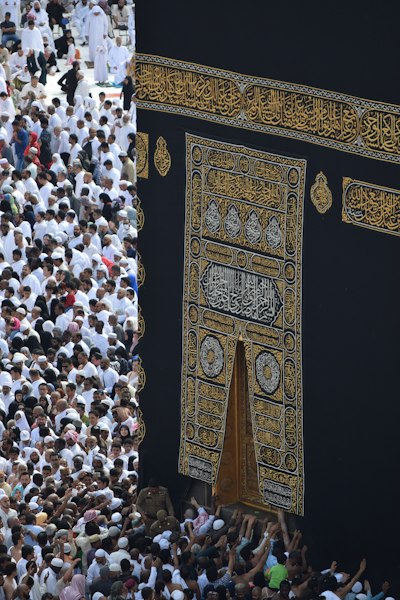
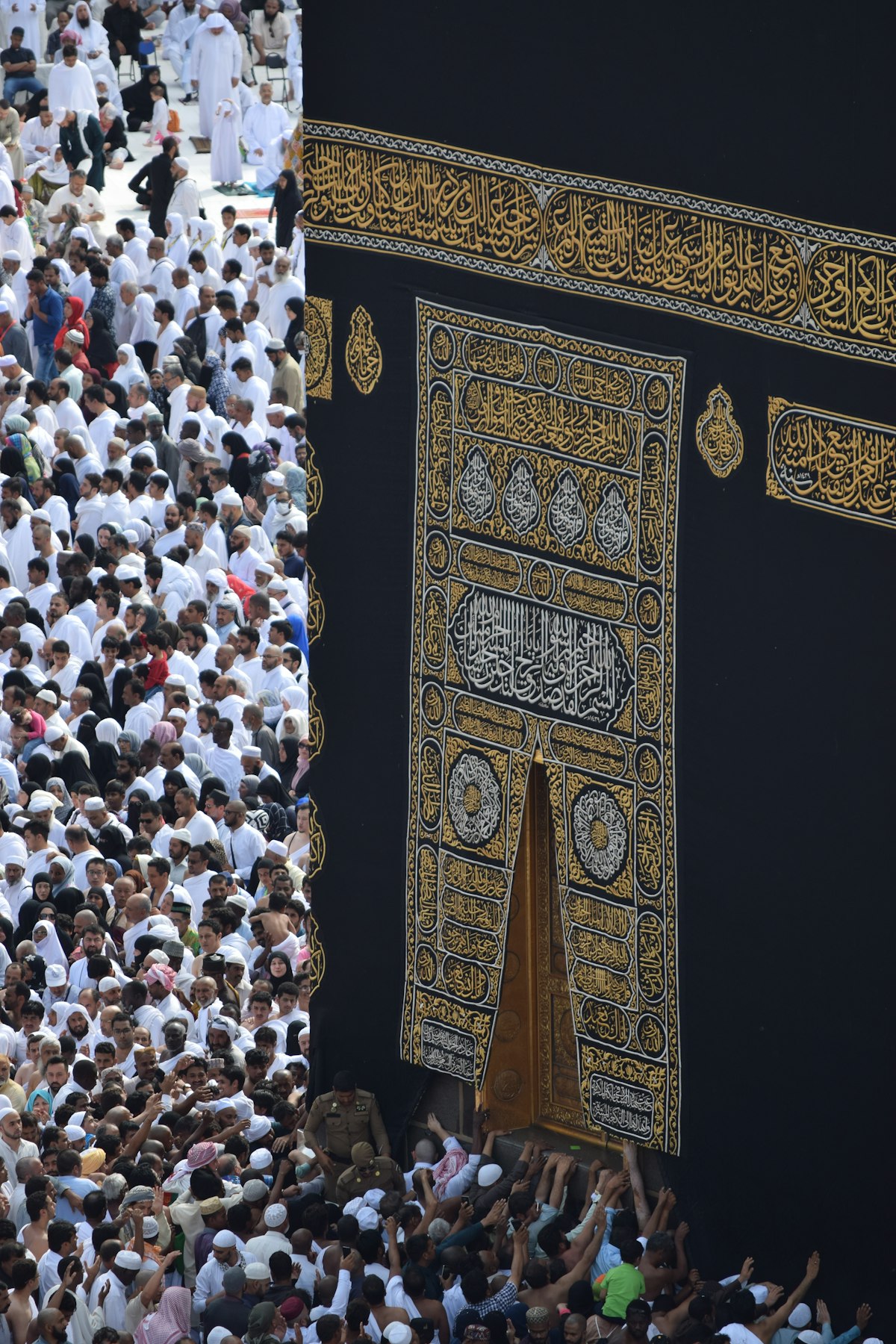
Tawaf is the act of walking around the Kaaba seven times in a counterclockwise direction. It is the heart of Umrah and one of the most spiritually powerful experiences a Muslim can have. For a deep dive into every aspect of this sacred ritual, see our comprehensive Tawaf guide with duas for each circuit.
Before You Begin Tawaf
- Ensure you have Wudu — Tawaf requires ritual purity. If your Wudu breaks during Tawaf, you must renew it and resume from where you stopped
- Men should perform Idtiba — Place your Rida (upper garment) under your right armpit and over your left shoulder, exposing the right shoulder. This is only for the Tawaf of Umrah
- Stop reciting the Talbiyah — Once you begin Tawaf, you stop the Talbiyah and switch to other duas and dhikr
How to Perform Tawaf — Circuit by Circuit
Starting Point: Position yourself so the Kaaba is on your left side. Begin at the Black Stone (Hajar al-Aswad) corner. If possible, touch or kiss the Black Stone. If the crowd is too dense (which it almost always is), simply face it and point with your right hand, saying:
"Bismillahi Allahu Akbar"
"In the name of Allah, Allah is the Greatest"
The Seven Circuits:
- Walk counterclockwise around the Kaaba, keeping it on your left
- Raml (brisk walking) — Men should walk briskly with short steps during the first three circuits. Walk normally for circuits 4-7
- There is no single specific dua prescribed for each round. You are free to make any dua, recite Quran, or engage in any dhikr
- Between the Yemeni Corner and the Black Stone, recite: "Rabbana atina fid-dunya hasanah wa fil-akhirati hasanah wa qina 'adhab an-nar" (Our Lord, give us good in this world and good in the Hereafter, and protect us from the torment of the Fire — Quran 2:201)
- At the start of each circuit, face the Black Stone, point to it and say "Bismillahi Allahu Akbar"
- The Hateem (Hijr Ismail) is considered part of the Kaaba. You must walk around it, not through it
You can also explore the sacred Kaaba area through our interactive VR Tawaf experience to familiarize yourself with the layout before your trip.
After Completing Tawaf
- Cover your right shoulder (end of Idtiba for men)
- Pray two rak'ahs behind Maqam Ibrahim (the Station of Ibrahim). If the area is crowded, you can pray anywhere in the mosque. Recite Surah al-Kafirun in the first rak'ah and Surah al-Ikhlas in the second
- Drink Zamzam water — Make dua while drinking, as the Prophet ﷺ said: "The water of Zamzam is for whatever purpose it is drunk for" (Ibn Majah 3062)
Step 3: Performing Sa'i Between Safa and Marwa
Sa'i commemorates Hajar's (the wife of Prophet Ibrahim عليه السلام) desperate search for water for her infant son Ismail. She ran between the two hills of Safa and Marwa seven times, and Allah rewarded her perseverance by causing the Zamzam spring to gush forth. For a detailed walkthrough with all the duas, read our complete Sa'i guide.
How to Perform Sa'i
Begin at Safa: Walk toward Mount Safa. When you can see the Kaaba, face it and raise your hands in dua. Recite:
"Innas-Safa wal-Marwata min sha'a'irillah"
"Indeed, Safa and Marwa are among the symbols of Allah" (Quran 2:158)
Then say: "Abda'u bima bada'Allahu bihi" — "I begin with what Allah began with."
Then make dua — this is one of the places where dua is accepted. The Prophet ﷺ would make dua three times at Safa, praising Allah and asking for whatever he needed.
Walk toward Marwa:
- Walk from Safa toward Marwa — this counts as one lap
- Green light area: Men should jog/walk briskly between the two sets of green fluorescent lights (marking the valley where Hajar ran). Women walk at their normal pace
- During the walk, make dua, recite Quran, or engage in dhikr. There is no specific dua prescribed for Sa'i, so pour your heart out to Allah
- When you reach Marwa, face the Kaaba (if visible), raise your hands, and make dua again
- Walking back from Marwa to Safa counts as the second lap
- Continue until you complete seven laps, ending at Marwa
Counting the laps: Safa to Marwa = 1, Marwa to Safa = 2, Safa to Marwa = 3, and so on. You start at Safa and end at Marwa after 7 laps.
Important: Wudu is not strictly required for Sa'i (unlike Tawaf), though it is preferred. The modern Sa'i area is air-conditioned and fully covered, with multiple floors including wheelchair-accessible levels.
Step 4: Halq or Taqsir (Shaving or Trimming Hair)
This is the final step of Umrah, and it symbolizes your spiritual renewal and submission to Allah.
- Halq (shaving the head completely) — This is preferred for men and carries a greater reward. The Prophet ﷺ made dua three times for those who shave their heads and once for those who trim
- Taqsir (trimming the hair) — Cutting at least a fingertip's length from all over the head. This is the only option for women — they should trim approximately an inch from the ends of their hair
Where to get it done: There are barber shops right outside Masjid al-Haram and throughout the streets of Makkah. Many offer head shaving for a few Saudi Riyals. Some pilgrims also carry small scissors and trim each other's hair.
After Halq or Taqsir, all Ihram restrictions are lifted. You can change into regular clothes, apply perfume, and resume normal activities. Your Umrah is now complete! Congratulations — may Allah accept your pilgrimage.
"And complete the Hajj and Umrah for Allah."
— Quran 2:196
Essential Duas for Every Stage of Umrah
While there are no mandatory duas for most of Umrah (you can make any personal dua), the following are recommended based on the Sunnah and the best duas taught by the Prophet ﷺ:
Dua When Leaving Home
"Bismillahi tawakkaltu 'alallah, wa la hawla wa la quwwata illa billah."
"In the name of Allah, I place my trust in Allah, and there is no might nor power except with Allah."
— Abu Dawud 5095
Dua at the Miqat
"Labbayk Allahumma bi 'Umrah."
"Here I am, O Allah, for Umrah."
Dua When First Seeing the Kaaba
"Allahumma zid hadhal-bayta tashreefan wa ta'zeeman wa takreeman wa mahabah. Allahumma anta as-salamu wa minka as-salam, fahayyina rabbana bis-salam."
"O Allah, increase this House in honor, esteem, nobility, and reverence. O Allah, You are Peace, and from You comes peace, so greet us, our Lord, with peace."
Dua During Tawaf (Between Yemeni Corner and Black Stone)
"Rabbana atina fid-dunya hasanah wa fil-akhirati hasanah wa qina 'adhab an-nar."
"Our Lord, give us good in this world and good in the Hereafter, and protect us from the punishment of the Fire."
— Quran 2:201
Dua After Tawaf (at Maqam Ibrahim)
"Wattakhidhu min Maqami Ibrahima musalla."
"And take the Station of Ibrahim as a place of prayer."
— Quran 2:125
Dua While Drinking Zamzam
"Allahumma inni as'aluka 'ilman naafi'an, wa rizqan waasi'an, wa shifaa'an min kulli daa'."
"O Allah, I ask You for beneficial knowledge, abundant provision, and healing from every disease."
Dua on Safa and Marwa
"La ilaha illallahu wahdahu la shareeka lah, lahul-mulku wa lahul-hamdu wa huwa 'ala kulli shay'in qadeer. La ilaha illallahu wahdahu, anjaza wa'dahu, wa nasara 'abdahu, wa hazamal-ahzaba wahdah."
"There is no god but Allah alone, with no partner. His is the dominion and His is the praise, and He is able to do all things. There is no god but Allah alone. He fulfilled His promise, supported His servant, and defeated the confederates alone."
— Sahih Muslim 1218
Common Mistakes to Avoid During Umrah
Even with the best preparation, first-time pilgrims often make mistakes that can affect the validity or quality of their Umrah. Here are the most common ones to watch out for:
- Passing the Miqat without Ihram: This is a serious error. If you realize you've passed the Miqat, you must return to it. If you cannot, you must offer a sacrifice (fidyah). If flying, put on your Ihram garments before boarding and make your niyyah when the pilot announces the Miqat
- Walking through the Hateem during Tawaf: The Hateem (Hijr Ismail) is considered part of the Kaaba. Walking through it means you haven't completed the full circuit. Always walk around it
- Pushing and shoving to touch the Black Stone: This is against the spirit of worship. The Prophet ﷺ said to Umar (RA): "O Umar, you are a strong man, do not crowd others at the Black Stone, for you will harm the weak." Simply point toward it from a distance
- Miscounting Tawaf circuits or Sa'i laps: If you lose count, take the lower number. Some pilgrims use a digital counter (tasbeeh counter apps work well)
- Reading duas from a book without understanding: While dua booklets are fine as a reference, the most powerful duas are those that come from your heart. Allah understands all languages — make dua in your own language if you don't know Arabic
- Raising your voice in collective dua during Tawaf: Following a group leader who shouts duas for everyone to repeat can disturb other worshippers. Individual, quiet dua is the Sunnah
- Not completing Sa'i at Marwa: Remember: Safa to Marwa is one lap, Marwa to Safa is two. You must end at Marwa after seven laps
- Women trimming too little hair: Some women cut just one or two strands. You should trim at least a fingertip's length from the ends of your hair for the Umrah to be valid
- Performing Umrah for the deceased without completing your own first: If you haven't performed Umrah for yourself, do that first before performing one on behalf of a deceased relative
Special Guidelines for Women Performing Umrah
Islam honors women equally in worship, and Umrah is no exception. Here are specific guidelines for sisters:
- Ihram clothing: Wear your regular modest clothing — any color is permissible. You do not need to wear white. Ensure your body is covered except for the face and hands
- Niqab in Ihram: The face should not be covered with a niqab that touches the skin. However, you may use a visor or hang a cloth from your head covering that falls over your face without touching it when non-Mahram men are nearby
- Talbiyah: Recite in a low voice, unlike men who recite loudly
- Raml and green lights: Women do not jog during Tawaf (first three circuits) or between the green lights during Sa'i
- Menstruation: If your period starts before Tawaf, wait until it ends, perform Ghusl, then complete your Umrah. You can still make dhikr and dua at the mosque but should not enter the prayer area or perform Tawaf until you are in a state of purity
- Halq/Taqsir: Women never shave their heads. Cut approximately one inch (a fingertip's length) from the ends of your hair, ideally from multiple places to ensure all areas are trimmed
For more tips specifically for women, check out our first-time Umrah tips article which covers everything from choosing comfortable shoes to managing crowds.
How to Practice Umrah Before You Go
One of the best things you can do before your trip is to familiarize yourself with the physical layout of Masjid al-Haram, the Kaaba, and the Sa'i corridor. This is where technology becomes an incredible tool for preparation.
With Pilgrim's Path's immersive VR Umrah experience, you can:
- Walk through a 360° virtual tour of the entire Umrah route
- Practice the Tawaf path around the Kaaba and understand where the Hateem, Maqam Ibrahim, and Zamzam station are located
- Experience the Sa'i corridor and locate the green fluorescent lights
- Hear the actual duas being recited at each stage
- Explore the Masjid al-Haram layout so nothing is unfamiliar when you arrive
This kind of virtual preparation dramatically reduces anxiety and lets you focus entirely on the spiritual experience when you're actually there.
Practice Umrah Before You Travel
Walk through every ritual in immersive 360° VR — completely free. Build confidence and focus on spirituality.
Start Your Virtual UmrahFrequently Asked Questions
How long does Umrah take to complete?
The actual rituals of Umrah can be completed in 3-6 hours, depending on crowd levels and your pace. During peak seasons (Ramadan, school holidays), Tawaf and Sa'i may take longer due to large crowds. Off-peak Umrah can sometimes be completed in under 2 hours. However, many pilgrims choose to take their time, spending extra hours in dua and worship at each station.
Can I perform Umrah during Ramadan?
Yes, and it is highly recommended. The Prophet ﷺ said: "Umrah in Ramadan is equal to Hajj" (Sahih al-Bukhari 1863). However, be prepared for significantly larger crowds and plan accordingly. Booking accommodations well in advance is essential for Ramadan Umrah.
What if I break my Wudu during Tawaf?
If your Wudu breaks during Tawaf, stop where you are, go and make fresh Wudu (there are Wudu areas on every floor of the mosque), and then resume your Tawaf from the exact point where you stopped. You do not need to start over. Keep mental note of which circuit you were on and where you stopped.
Is there a specific dua for each circuit of Tawaf?
No. Despite what many dua booklets suggest, there is no authentic hadith prescribing specific duas for each circuit. The Prophet ﷺ only recommended the dua between the Yemeni Corner and the Black Stone (Rabbana atina...). You are free to make any dua in any language during the rest of Tawaf. This is actually a blessing — speak to Allah from your heart.
Can I perform multiple Umrahs in one trip?
Yes, you can perform multiple Umrahs during a single trip to Makkah. To do so, go to Masjid Aisha (Taneem) — the nearest Miqat for those already in Makkah — enter Ihram again, and repeat the Umrah rituals. Many pilgrims perform an extra Umrah on behalf of deceased parents or relatives.
What happens if I accidentally violate an Ihram restriction?
If you violate a restriction unintentionally (such as accidentally covering your head or using scented soap), there is no penalty as long as you remove the violation immediately upon realizing it. Intentional violations may require a fidyah (expiation), which can be fasting three days, feeding six poor people, or sacrificing a sheep — the pilgrim may choose whichever is easiest.
Is Sa'i mandatory, or can I skip it?
Sa'i is a pillar (rukn) of Umrah according to the majority of scholars. Skipping it would invalidate your Umrah. It cannot be compensated with a sacrifice — you must perform it. If you are physically unable to walk, you can perform Sa'i in a wheelchair (available for rent at the mosque).